Category: Energy Blog

  • TV Backlights

    TV Backlights

    So, my mind was drawn back to the original reason for why I was doing this i.e. reducing energy bills.
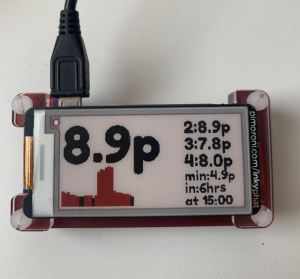
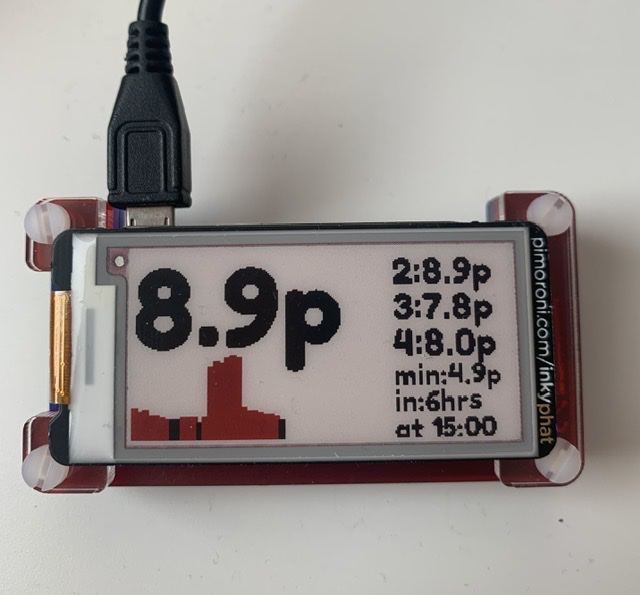
    I already had my Raspberry Pi Zero running the display in the kitchen showing us the current electricity price and a graph of how that was changing throughout the day. This worked but I was sure we could do better.

    I then discovered that there was also an integration for Octopus Energy for Home Assistant and so I went ahead and installed that. This meant that I could pull in the data automatically from Octopus for my “Agile” Electricity tarrif and use that for whatever I needed.
    One of the first things I did was set up an automation between the Philips Hue integration and the Octopus Energy one so that my TV striplights in the lounge change colur depending upon the current electricity price.

    Thinking back to my pre-crisis price, I set the colours to display Green when the price was 19p or under, Amber (Yellow) when between 19p and 27p (The current standard price that most people are paying) and red when over 27p. After a few weeks, I also added Blue when the price dropped to zero or went into negative pricing.

    At this point, I was using my browser to connect to Home Assistant to view the data although initially, I didn’t set up all that much to look at.

  • Home Assistant

    Home Assistant

    For many years, I had been dabbling with smart home technology, particularly with Homeseer which was a decent enough system but every time I wanted to add something to the setup, there were significant costs. I’d run various things on it for over 10 years but the costs were prohibitive. Also, there was no integration with Apple’s Homekit and as many of our devices were Apple, this was far from ideal.
    Whilst playing around with the display for Octopus Agile, I’d stumbled upon GitHub and many many links to Home Assistant.

    This was an absolute game changer for me and so I decided to wander down this rabbit hole and see where I ended up.
    I already had a Raspberry Pi 3 which I wasn’t using but decided to purchase a new Raspberry Pi 4. I also got a case for it, added an SD card and a power supply and followed the instructions Here to get it up and running.

    Very quickly, I had a working version of Home Assistant running and it had already scanned my local network and picked up various devices and integrations. This was a huge improvement on Homeseer and none of the associated costs either. I started configuring the integrations, the first one being the Philips Hue as I already had plenty of lights, switchs and dimmers installed. This worked a treat and I could now receive inputs from the switches and also control all my Hue lights.

    This really was a “Lightbulb” moment and I could see a huge potential for the future.

  • Agile Display

    Agile Display

    So, to try and make things easier, I discovered an article on the Octopus web site https://octopus.energy/blog/agile-smart-home-diy/ which showed how to configure a Raspberry Pi Zero to become a smart display. It links to the Octopus Energy API and automatically downloads the upcoming rates every evening and changes the display every half an hour to show the current electricity rate and a graph showing when it is going up and down.

    This was a real game-changer for us and once stuck in a case and mounted in the kitchen, it meant we could choose when to set the washer or dishwasher going to minimise the costs.

    All the details on where to get the bits and how to set it up are here: https://github.com/pufferfish-tech/octopus-agile-pi-prices/blob/master/README.md

  • Living with Agile

    Living with Agile

    We already had Smart Meters so the move to Agile was pretty painless and once done, we could then track the pricing and make some educated decisions about our usage.
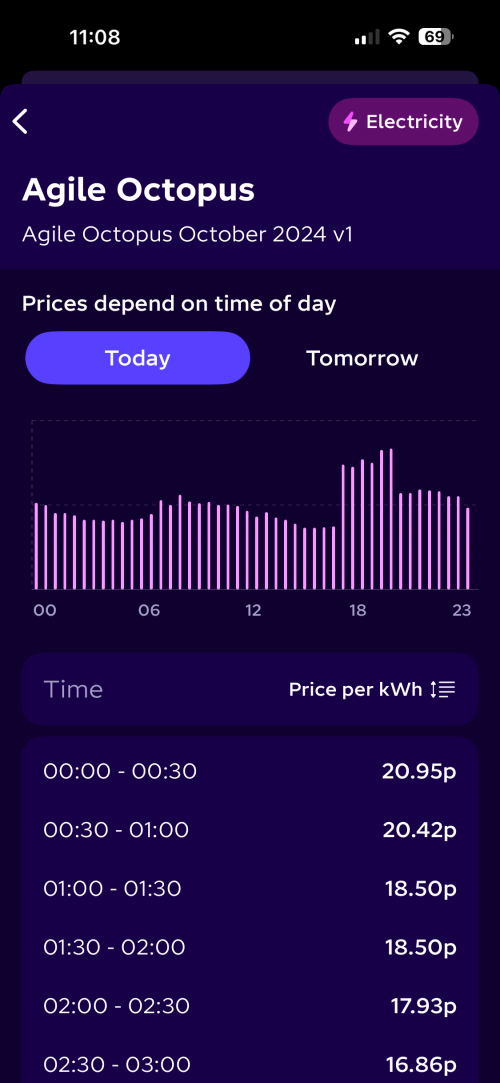
    Generally speaking, the pricing would fluctuate for most of the day depending upon external influences like how windy it was. More wind equals more windpower generated and cheaper costs. However, the sting is between 4pm and 7pm each evening which is always the peak time as people get home from School and Work, make a brew, cook tea, watch TV etc. This peak pricing can go much higher that the other hours in the day and is capped at a maximum of £1 per kWh which is huge and it has reached that several times whilst I have been with Agile.

    The rates can be viewed via the App but Octopus have created various ways to allow others to develop solutions to ingegrate with other things and that’s what this Blog is all about; much more on this later on.

    However, in the early days, I tried to think about the “Mrs” effect i.e. how much she engaged with the idea of saving energy costs compared to the effort required to enable us to do this. The App was a good start and she started to check the hourly rates to use energy at the best times so we were already on to a good thing, I just wanted to make things a bit easier for us all.

    I also had in the back of my mind the energy costs prior to the energy crisis and if I could manipulate our usage to match those figures (£188 per month and 19p per kWh) then in my mind I was winning. If I could beat those prices, I was REALLY winning.


  • Becoming Agile

    Becoming Agile

    With massive energy cost increases looming, I had to do something drastic and that is when I discovered “Octopus Agile”. I had been with Octopus for several years now and been very happy with the way they operated as a Company and the prices I had paid previously. Octopus Agile was and still is an “Agile” Tarrif that changes price every 30 minutes and is aligned with the wholesale energy prices. That means that when Octopus are paying low prices for electricity, so am I and it encourages me to load-shift my heavier energy usage to times when the prices are lower.

    Previously, I would just put the dishwasher on or the washing machine at times that were most convenient to me and I suspect were also convenient to the rest of the UK and hence we’d all be using appliances at the same time, demand would shoot up and so would the wholesale energy costs because they’d then have to fire up additional generating plants or buy-in electricity from some of the global interconnectors. Changing my habits could reduce my costs and actually help out the National Grid by (In a very small way) balancing it a little more than it would have ben by using appliances at peak times.
    It also meant that I would be using greener energy sources which is a bonus.

  • Where my energy journey started

    Like most people, I had simply renewed my annual bills by keeping the same supplier. When I bought my first house, I got my landline from BT, Gas from British Gas and Electricity from Norweb and it stayed that way for a number of years until suddenly, I found I could get my electricity from British Gas and any number of new suppliers that sprung up. There followed a few years where, cautious of the new suppliers, I eventually started to research who provided the best service and also the best value, not necessarily the cheapest overall.

    From then on, every year when contracts came up for renewal, I’d do the research and opt for the best supplier I could find. I have no doubt this saved me money in the long run as to my cost, I found out that I didn’t have to purchase my home insurance from my mortgage supplier and was astounded that they’d just put the price up a bit more every year so that when I did look elsewhere, I managed to find better cover for a quarter of the cost!

    Fast forward to August 2021 when, on renewal, I managed to lock-in my energy prices to 18.46p per kWh for electricity and 3.88p for Gas for the next 2 years.
    It wasn’t long after that when the energy crisis hit and thankfully, I was locked-in to the lower rate to protect me for the next couple of years.

    So, nearly 2 years down the line, energy prices had stabilised a little but my renewal quote was looking at 29.94 pence for electricity and 7.51 pence for gas. I had been paying £188 per month for my combined energy usage and so how on earth was I going to be able to afford any future energy bills? Time to do some more research………..